
Table of Contents
- Why Botanical Hair Care for Thinning Is Worth Trying
- How We Chose What to Recommend
- Does Thinning Shampoo Work? What to Expect From a Wash-Out Formula
- Rosemary Oil for Hair Growth: The Botanical Most Often Studied
- Natural Remedies for Hair Thinning That Support the Scalp
- Scalp Care for Hair Growth: A Simple Weekly Routine
- Ingredients to Avoid in Botanical Hair Care for Thinning
- Frequently Asked Questions
Last Updated: October 9, 2026
Why Botanical Hair Care for Thinning Is Worth Trying
Many people notice their hair changing before they understand why. The shedding, the widening parting, the ponytail that suddenly feels thinner. If that sounds familiar, botanical hair care for thinning is worth a serious look, not because it promises miracles, but because it works with your scalp rather than stripping it.
At Izzy Rose Skin, we formulate around a simple idea: healthy hair starts with a calm, nourished scalp. Botanical hair care is the practice of using plant-derived oils, extracts and gentle cleansers to support scalp health, reduce breakage and create better conditions for the hair growth cycle.

Below, we break down what actually works, what to expect from a wash-out shampoo, and how to build a weekly scalp routine you will stick to.
How We Chose What to Recommend
Our approach is straightforward: we favour formulas with short, purposeful ingredient lists and no unnecessary filler. We looked at how each botanical is traditionally used in scalp care, whether it suits sensitive or reactive scalps, and whether it fits into a realistic routine.
We also considered formulation style. Concentrated oils and treatments that stay on the scalp tend to deliver more contact time than a shampoo that rinses away in seconds. That distinction shapes most of what follows.
Does Thinning Shampoo Work? What to Expect From a Wash-Out Formula
Thinning shampoo can help, but it is a supporting player, not the headline act. Most of the active ingredients in a shampoo are in contact with your scalp for under a minute before rinsing.
What a good shampoo can do:
- Cleanse without stripping natural oils
- Reduce scalp buildup that can clog follicles
- Avoid harsh sulfates that leave hair brittle and prone to breakage
What it cannot do is reverse thinning on its own. If you want botanical ingredients to actually reach the follicle, leave-on treatments matter. Think of shampoo as preparation and leave-in care as the treatment.
Rosemary Oil for Hair Growth: The Botanical Most Often Studied
Rosemary oil for hair growth earns its reputation because it is one of the few botanicals with a plausible, well-described mechanism rather than folklore alone.
That is why rosemary is often discussed alongside peppermint, which contains menthol and produces a cooling, tingling sensation that users associate with increased blood flow, and alongside saw palmetto, a botanical frequently used in scalp care for its perceived role in supporting a balanced scalp environment.
How rosemary compares with other commonly used botanicals
| Botanical | Main compounds | Perceived role in scalp care | Best for |
|---|---|---|---|
| Rosemary | Rosmarinic, carnosic, ursolic acids | Supports microcirculation and antioxidant defence | General thinning, dull scalp |
| Peppermint | Menthol | Cooling, invigorating sensation | Oily or congested scalps |
| Tea tree | Terpinen-4-ol | Helps keep the scalp clean and balanced | Flaky, buildup-prone scalps |
| Saw palmetto | Fatty acids, phytosterols | Supports a balanced scalp environment | Hormonal-pattern thinning |
| Jojoba | Wax esters | Mimics sebum, conditions without heaviness | Dry, reactive scalps |
How to use rosemary oil well
- Dilute it. Never apply essential oil neat. A common guide is around 2-3 drops of rosemary essential oil per 10 ml of carrier oil such as jojoba or argan. For a reactive scalp, start at the lower end.
- Massage for two to five minutes. Use your fingertips in small circles across the scalp, working in sections. This is not just about spreading the oil, the massage itself is part of the treatment.
- Leave it on. At least an hour is a reasonable minimum; overnight gives more contact time but needs a towel over your pillow.
- Wash out thoroughly. A gentle sulfate-free shampoo removes the oil without stripping the scalp.
- Repeat two to four times per week. Consistency over months matters far more than intensity in a single session.
Trade-offs worth knowing
Rosemary oil is not suitable for everyone. If you have a known allergy to plants in the Lamiaceae family, mint, basil, sage, lavender, patch-test first on the inner forearm and wait 24 hours.
If you would rather not mix your own blend, our Thrive scalp and hair growth oil (£25.00) combines rosemary, jojoba, argan, peppermint, tea tree and vitamin E in one pipette-applied treatment, so the dilution is already done for you.
Natural Remedies for Hair Thinning That Support the Scalp
Most guides to natural remedies for hair thinning stop at the scalp. That is only half the picture. Hair is one of the first things the body deprioritises when something is off internally, so topical botanicals work alongside other factors: nutrition, stress, sleep and gut health.
The internal side of the equation
- Iron and ferritin. Low iron stores are a common and often overlooked contributor to diffuse shedding, particularly in menstruating women. A GP can check ferritin with a simple blood test.
- Vitamin D. Low levels are widespread in the UK, especially through winter, and are associated with hair shedding. The NHS advises a daily supplement of 10 micrograms during autumn and winter.
- Protein. Hair is largely protein. Very low-protein diets, or periods of rapid weight loss, can show up as thinning several months later.
- Stress. A stressful event can trigger a shed roughly two to three months afterwards, a pattern known as telogen effluvium. Managing stress does not fix it overnight, but it shortens the cycle.
- Gut health. Poor digestion can affect how well you absorb the nutrients above. If you have ongoing bloating, irregularity or a diagnosed condition such as coeliac disease, that is worth addressing with a GP rather than a shampoo.
None of this replaces topical care. It sits underneath it. A scalp oil cannot compensate for a ferritin level of 10.
Thrive - scalp and hair growth oil *NEW →
The external side: matching the botanical to the concern
| Concern | Botanical approach | Mechanism | How often |
|---|---|---|---|
| Dry, flaky scalp | Jojoba and tea tree oil massage | Jojoba mimics sebum; tea tree's terpinen-4-ol helps keep the scalp balanced | 2-3 times weekly |
| Weak, brittle hair | Argan oil on lengths and ends | High in vitamin E and fatty acids; smooths the cuticle and reduces friction breakage | After each wash |
| Poor scalp circulation | Rosemary oil with a 5-minute massage | Rosmarinic and carnosic acids support microcirculation; massage adds mechanical stimulation | 2-4 times weekly |
| Buildup and congestion | Gentle sulfate-free cleanse | Removes sebum and product residue without stripping the lipid barrier | Every wash |
| Hormonal-pattern thinning | Saw palmetto in a leave-on tonic | Phytosterols and fatty acids used to support a balanced scalp environment | Daily, as part of a routine |
Application technique matters more than most people think
The single biggest mistake is applying oil to the hair rather than the scalp. The follicle sits beneath the skin, so the oil needs to reach the skin to be useful. A short, repeatable technique beats a long, occasional one:
- Part your hair in rows about 2 cm apart, working from the front hairline backwards.
- Use a pipette to place a drop directly on the scalp along each parting, not on the hair.
- Massage in small circles with your fingertips (not nails) for two to five minutes, moving across the whole scalp.
- Add a gentle pinch technique, press and release the scalp between finger and thumb, to encourage movement without dragging the hair.
- Leave on for at least an hour, then wash out with a sulfate-free shampoo.
Frequency and technique are important.
If you also deal with dry or reactive skin, the Glow & Grow Bundle (£45.00) pairs our scalp oil with Calm Balm, so you can soothe stressed skin and nourish your scalp in one routine.

Scalp Care for Hair Growth: A Simple Weekly Routine
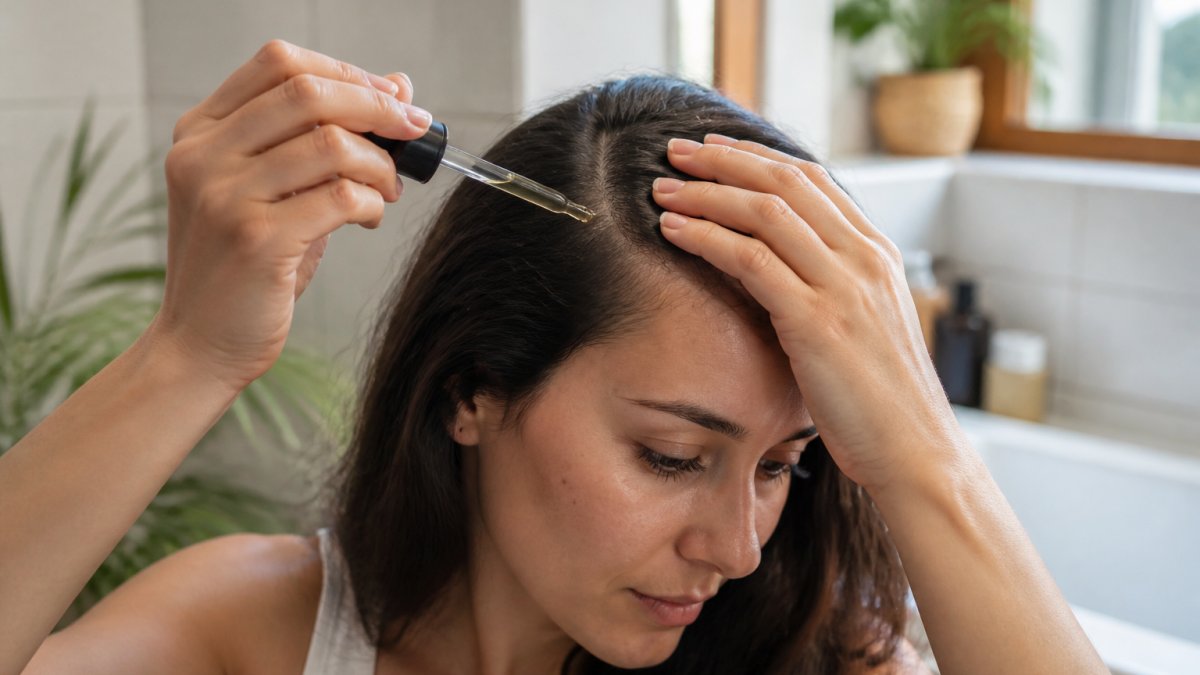
Scalp care for hair growth does not need to be complicated. A consistent weekly rhythm beats an occasional intensive treatment every time.
- Cleanse gently. Use a sulfate-free shampoo to remove buildup without stripping.
- Apply oil to the scalp. Part your hair in sections and use a pipette to reach the skin directly.
- Massage for 2-5 minutes. Use your fingertips in small circles to encourage scalp circulation.
- Leave it on. At least one hour, or overnight for a more intensive treatment.
- Wash as normal. Rinse thoroughly and style as usual.
Repeat this two to four times per week. Consistency matters more than quantity.
If you also deal with dry or reactive skin, the Glow & Grow Bundle (£45.00) pairs our scalp oil with Calm Balm, so you can soothe stressed skin and nourish your scalp in one routine.
Ingredients to Avoid in Botanical Hair Care for Thinning
Reading the label is where most people gain the biggest advantage. A product can call itself natural and still contain ingredients that leave a sensitive scalp feeling worse.
Watch for:
- Sulfates that strip natural oils and leave hair brittle
- Silicones that coat the hair and can build up on the scalp
- Artificial fragrance that irritates reactive skin
- Parabens and unnecessary fillers that add nothing to the formula
Look instead for short lists built around jojoba, argan, rosemary, peppermint, tea tree and vitamin E. If you cannot pronounce half the label, that is usually a sign to put it back.
The Hair + Skin Glow Set (£46.75) is built on this principle: concentrated formulas with no unnecessary filler, free from parabens and artificial fragrance.

Thinning hair rarely has a single cause, and it rarely has a single fix. What it does respond to is consistency: a gentle cleanse, a botanical oil massaged into the scalp several times a week, and formulas that respect a sensitive scalp. Izzy Rose Skin makes small-batch botanical haircare with concentrated, purposeful ingredients, including our Thrive scalp and hair growth oil and the Glow & Grow Bundle.
Frequently Asked Questions
Does thinning shampoo work?
A shampoo can improve the look of thinning hair by removing scalp buildup and adding volume, but it stays on the scalp for less than a minute before rinsing, so botanical extracts have limited contact time. Think of it as preparation: a gentle, sulfate-free wash clears the way for a leave-in botanical tonic or scalp oil, which stays on for an hour or overnight and gives ingredients far more time to work.
How long does it take to notice a difference from a new hair-care routine?
Hair grows roughly 1 cm per month, so visible change takes patience. Photograph your parting in the same light each month so you are judging progress on evidence rather than memory. If shedding continues or worsens after six months, see a GP.
Can botanical hair products help improve the appearance of thinning hair?
They can improve how thinning hair looks and feels. Botanical oils such as jojoba, argan and castor soften the hair shaft, reduce breakage and add shine, while regular scalp massage supports scalp circulation. This is cosmetic support, not a medical treatment. If thinning is sudden, patchy or accompanied by itching, soreness or scaling, book an appointment with your GP, who can check for thyroid issues, iron deficiency or other causes.
How should you use botanical scalp oils and shampoos?
Apply oil directly to the scalp in sections using a pipette, not to the lengths. Massage gently for two to five minutes, leave for at least an hour or overnight, then shampoo thoroughly. Use it two to four times per week. Keep shampoo to a gentle, sulfate-free formula and focus it on the scalp rather than the ends. Overnight treatments are best on a night when you can wash your hair the following morning.
When should you seek medical advice about hair thinning?
See your GP if hair loss is sudden or patchy, if your scalp is inflamed, sore or scaly, or if you are losing clumps rather than gradual density. Thinning can also follow pregnancy, illness, crash dieting or thyroid changes, and these causes need a proper diagnosis. A GP can arrange blood tests for iron, thyroid and vitamin levels, and may refer you to a dermatologist. Botanical care works alongside that advice, not instead of it.


