
Last Updated: October 23, 2026
Quick Summary
A gentle botanical hair growth routine works with your scalp by using mild cleansing, plant oils, steady massage and realistic expectations instead of harsh treatments. Build it around your hair type, dilute essential oils properly, and patch test before use. Expect softer, calmer-feeling hair first, since visible growth takes months, not weeks.
- Wash the scalp and condition the lengths, keeping conditioner off the roots.
- Dilute essential oils to roughly one to two drops per tablespoon of carrier oil.
- Patch test on your inner forearm and wait 24 to 48 hours before scalp use.
- Massage the scalp with fingertips or a soft silicone brush for five minutes.
- See a GP if hair loss is sudden, patchy or persistent despite a consistent routine.
Table of Contents
- Why a Gentle Botanical Hair Growth Routine Beats Aggressive Treatments
- What You'll Need Before You Start
- Step 1: Build a Gentle Scalp Care Routine Around Your Hair Type
- Step 2: Choose a Botanical Hair Oil for Scalp Support
- Step 3: Scalp Massage for Hair Growth and Better Circulation
- Step 4: Picking Hair Growth Oils for Sensitive Scalp Types
- Step 5: Conditioning, Breakage Prevention and Buildup Management
- Step 6: Track Progress, Troubleshoot and Know When to See a GP
- Frequently Asked Questions
Why a Gentle Botanical Hair Growth Routine Beats Aggressive Treatments
A gentle botanical hair growth routine works with your scalp, not against it. Harsh shampoos, hot tools and daily washing can leave the scalp tight and irritated. A calmer approach protects the skin barrier and gives hair follicles a better environment to work in.
The logic is simple. Hair grows from follicles sitting in your scalp. If that skin is inflamed, dry or overloaded with product, growth conditions suffer. Gentle botanical hair care swaps aggression for consistency: mild cleansing, plant oils, steady massage and realistic expectations.
Below, we'll show you exactly how to build that routine, step by step, with safety guidance most guides skip.
What You'll Need Before You Start
Gather your kit first so the routine runs smoothly. You need a botanical hair oil, a gentle shampoo, a wide-tooth comb and a soft scalp massage tool or your fingertips. A conditioning balm helps dry lengths.
If you'd rather start with everything in one box, the Skin & Scalp Ritual Set brings together a calming balm, a whipped tallow cream and a scalp oil.
Step 1: Build a Gentle Scalp Care Routine Around Your Hair Type
Match frequency to your hair and scalp, not to a generic schedule. The table below is a starting point, not a rule, adjust after two to three weeks based on how your scalp feels.
| Hair and scalp type | Wash frequency | Pre-wash oiling | Scalp massage | Deep conditioning |
|---|---|---|---|---|
| Fine or oily hair, oily scalp | Every 2-3 days | Once weekly, 30 minutes before washing | 3-4 times weekly, 3-5 minutes | Once weekly, mid-lengths only |
| Medium hair, balanced scalp | Every 3-4 days | Once or twice weekly | 3 times weekly, 5 minutes | Once weekly |
| Dry, coily or curly hair | Every 5-7 days | Once or twice weekly, up to 1 hour | 2-3 times weekly, 5 minutes | Once or twice weekly |
| Sensitive or reactive scalp | Every 3-4 days with a fragrance-free mild shampoo | Patch test first; start once weekly | Fingertips only, 2-3 times weekly | Once weekly, avoiding the scalp |
Your gentle scalp care routine should include:
- A mild shampoo, applied to the scalp only and rinsed thoroughly
- A pre-wash botanical oil once or twice weekly, worked into the scalp in sections
- Scalp massage for a few minutes, several times a week, with fingertips or a soft silicone brush
- Conditioner on mid-lengths and ends, not the roots
- A weekly deep-conditioning mask on dry lengths if your hair snaps or feels rough
A few practical rules keep the schedule gentle:
- Wash the scalp, condition the lengths. Shampoo belongs at the roots; conditioner belongs from mid-length down.
- Oil before washing, not after. Pre-wash oiling lifts flakes and softens the scalp, then the shampoo removes the residue so follicles are not left coated.
- Reduce, don't add, when the scalp complains. Tightness, itching or flaking means you are overdoing something, drop the oil frequency first, then the massage, then the wash frequency.
Watch how your scalp feels 24 hours after each wash. Comfortable and calm means the schedule fits. Tight, itchy or flaky means step it back. A routine that suits your hair type is the one you will actually keep, and consistency matters more than any single product.
Step 2: Choose a Botanical Hair Oil for Scalp Support
Pick a botanical hair oil for scalp use that lists its full ingredients and suits reactive skin. Look for jojoba, argan or castor oil as the base. These carrier oils condition without the sting of neat essential oils.
Our Thrive Hair & Scalp Oil blends jojoba, argan and castor oils with vitamin E and aromatic botanicals. It's designed for pre-wash scalp massage and dry ends.

Dilution, Patch Testing and Ingredient Safety
Dilute essential oils to roughly one to two drops per tablespoon of carrier oil. Patch test on your inner forearm and wait 24 to 48 hours before using anything on your scalp. Stop immediately if you feel burning, stinging or swelling.
Step 3: Scalp Massage for Hair Growth and Better Circulation
Scalp massage for hair growth is about consistency, not pressure. Use your fingertips or a soft silicone brush in small circles for five minutes. Move across the whole scalp, not just the thinning areas.
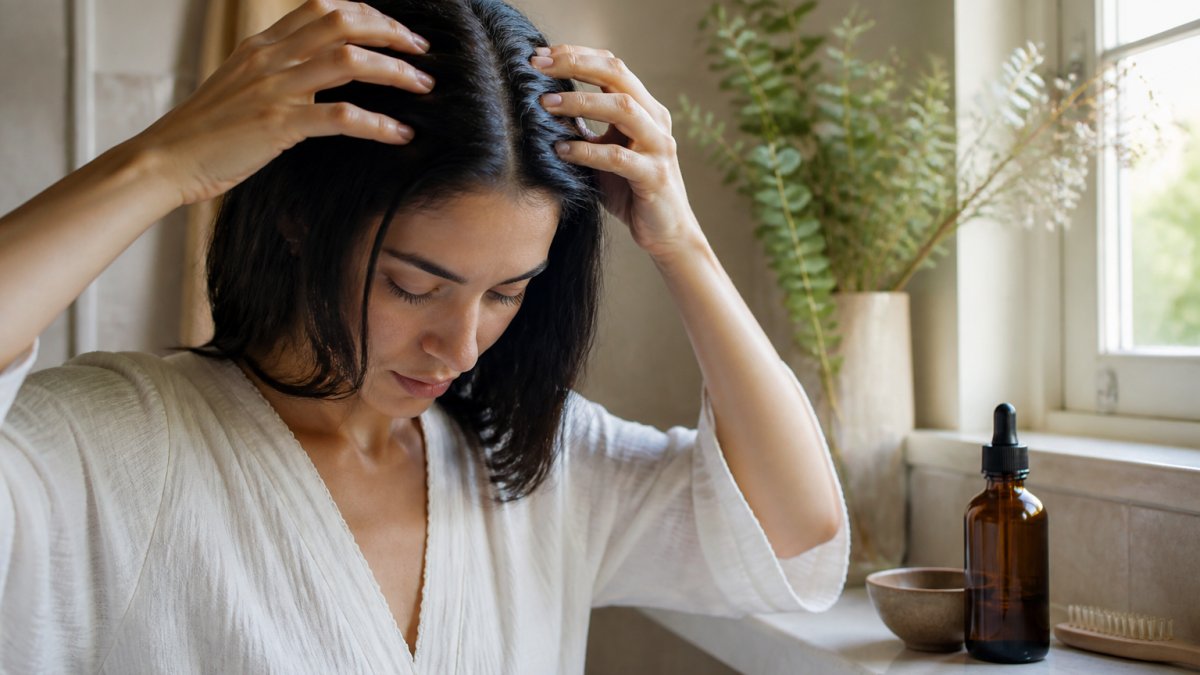
Massage supports blood flow to the scalp and helps you apply oil evenly. It also feels good, which matters. A routine you enjoy is a routine you keep.
Step 4: Picking Hair Growth Oils for Sensitive Scalp Types
Hair growth oils for sensitive scalp types need short ingredient lists. Fewer ingredients means fewer chances of a reaction. Avoid strong fragrance, menthol and cooling agents, which often cause stinging.
For reactive skin, the Dry Skin & Scalp Care Duo pairs a calming balm with the scalp oil.

Step 5: Conditioning, Breakage Prevention and Buildup Management
Conditioning is where breakage prevention happens. Dry hair snaps more easily, so keep lengths soft with a conditioning balm or a weekly hair mask. Apply from mid-length down, then rinse well.
Buildup is the quiet problem. Too much oil or heavy product leaves the scalp coated and clogged. Wash thoroughly after oiling, and don't layer oil on unwashed hair for days.
The Hair & Face Oil Duo offers a lightweight option for conditioning hair and skin without heaviness.

Step 6: Track Progress, Troubleshoot and Know When to See a GP
Most guides stop at "be patient". This section gives you a way to measure whether the routine is working, and clear thresholds for seeking medical advice.
A simple tracking method
Keep a one-page log and update it weekly:
- Shedding count. On wash day, collect the hair that comes out in the shower and on the comb. A rough count is enough, you are looking for a trend, not a precise number.
- Breakage check. Run a wide-tooth comb through conditioned hair from mid-length to ends. Short broken strands on the comb signal breakage rather than shedding.
- Scalp symptoms. Note itching, flaking, redness, tenderness or stinging, and which product preceded it.
- Photos. Take a photo of the same parting and hairline in the same light, same angle, once a month. Monthly photos reveal change that daily mirror checks hide.
- Routine notes. Record wash frequency, oiling frequency and any new product, so you can link cause to effect.
Shedding, breakage or hair loss?
These three look similar but need different responses:
- Shedding is normal daily fall, commonly described as around 50 to 100 hairs a day, though the exact figure varies by person, season and hair length. A temporary increase after illness, stress or a change in routine is common and usually settles.
- Breakage shows as short broken strands, split ends and roughness, often from heat, tight styling or dry lengths. It responds to conditioning, gentler handling and trimming, not to scalp treatments.
- Hair loss shows as widening partings, a receding hairline, patchy areas or visible scalp. It is a change in density, not just daily fall, and it warrants professional assessment.
Troubleshooting the routine
- Itchy or flaky scalp after oiling: oil may be too heavy or left on too long. Shorten the pre-wash time and wash more thoroughly.
- Stinging or redness: stop the product. This can indicate irritation or contact dermatitis; patch test any replacement on the inner forearm for 24 to 48 hours first.
- Hair feels coated or limp: buildup from oil or conditioner. Double-cleanse the scalp and keep conditioner off the roots.
- No visible change after three months: review the log. If shedding is stable and the scalp is calm, the routine is likely supporting hair health even if growth is not yet obvious. If density is still falling, seek advice.
When to see a GP
Book an appointment if you notice:
- Sudden or rapid hair loss, or loss in patches
- A painful, scaly, weeping or persistently inflamed scalp
- Shedding that continues for several weeks without settling
- Thinning that is progressing despite a consistent gentle routine
- Hair loss alongside fatigue, weight change, heavy periods or other systemic symptoms
A botanical routine supports scalp health; it is not a substitute for medical assessment when loss is persistent or unexplained.
A gentle routine takes months, not weeks. Expect softer, calmer-feeling hair first; visible growth comes later. Track monthly, troubleshoot early, and see a GP if loss is sudden, patchy or persistent.
Frequently Asked Questions
How often should I use botanical oils on my scalp?
Once or twice a week is enough for most people starting a botanical hair growth routine. Apply the oil to the scalp in sections, massage for five to ten minutes, and leave it for at least 30 minutes before shampooing thoroughly. If your scalp is very dry you can leave it longer, but avoid overnight oiling on a sensitive scalp until you know how it reacts. Daily massage without oil is fine and often easier to keep up with.
Can essential oils irritate a sensitive scalp?
Yes. Essential oils are concentrated plant extracts and can cause itching, redness or a burning sensation, especially on a reactive scalp. Always dilute them in a carrier oil, keep the blend low, and patch test on the inner forearm for 24 to 48 hours before using it on your head. If you have eczema, rosacea or a history of contact dermatitis, start with a ready-made botanical hair oil for scalp use rather than mixing your own.
How long does it take to see results from a hair growth routine?
Hair grows roughly 1 cm per month, so any change in thickness or length takes months, not weeks. Give a gentle botanical hair growth routine at least three to four months before judging it, and take photos in the same light on the same day each month to compare. Early wins tend to be feel rather than length: a calmer scalp, less flaking, softer lengths and less breakage when combing.
When should I seek medical advice about hair loss?
Speak to a GP if you notice sudden or patchy shedding, a receding hairline, widening partings, scalp pain, or hair loss alongside tiredness, weight change or heavy periods. Also see a GP if a product causes a rash, blistering or swelling. In the UK, a pharmacist can advise on mild scalp irritation, and a GP can refer you if needed.
Building a routine that respects sensitive skin takes patience, and the right products make it easier to stay consistent. Izzy Rose Skin makes small-batch botanical haircare and concentrated tallow skincare designed for dry, reactive skin. Our Thrive Hair & Scalp Oil supports a pre-wash scalp ritual, while our calming balm and tallow cream care for dry-feeling skin. Get started with Izzy Rose Skin and give your scalp a gentler daily habit.


