
Last Updated: October 28, 2026
Quick Summary
Is tallow balm safe for eczema? For many people with eczema-prone skin it can be, but side effects usually come from added ingredients rather than the tallow itself. Read the full ingredient list and patch test on the inner forearm before using it widely.
- Side effects are often caused by added ingredients, not the tallow itself.
- Check the full ingredient list before buying.
- Patch test on the inner forearm, watching for reactions at 24, 48 and 72 hours.
- Do not use tallow balm on weeping, bleeding, or infected skin.
- Infants under 12 months should not use tallow balm without medical advice.
Table of Contents
- What Tallow Balm Is and Why People With Eczema Try It
- Does Beef Tallow Help Eczema? What the Evidence Shows
- Tallow Balm Side Effects and Who Should Be Cautious
- How to Patch Test Skincare for Sensitive Skin
- Eczema Skincare Ingredients to Avoid
- How Tallow Balm Compares With NHS-Recommended Eczema Care
- When Not to Use Tallow Balm on Eczema, and Using It on Children
- Choosing Your Next Step: Testing a Calm, Simple Routine
- Frequently Asked Questions
What Tallow Balm Is and Why People With Eczema Try It
Izzy Rose Skin makes its tallow products in small batches in the UK. Is tallow balm safe for eczema-prone skin?
Izzy Rose Skin's Pure Whipped Tallow (£35.00) and Calm Balm (£30.00) are the two products most people compare when they start looking into tallow for dry, reactive skin.
Does Beef Tallow Help Eczema? What the Evidence Shows
For more on how tallow balm fits with eczema-prone skin, see Can Tallow Help Eczema? What to Know and Tallow Balm for Eczema-Prone Skin.
Tallow Balm Side Effects and Who Should Be Cautious
Tallow balm side effects are often caused by added ingredients rather than the tallow itself. Read the full ingredient list before you buy.
The article notes that side effects often come from added ingredients rather than the tallow itself, so check the full list before buying.
| Product | Price | Note |
|---|---|---|
| Pure Whipped Tallow | £35.00 | Includes several botanical oils |
| Calm Balm | £30.00 | Contains calendula and chamomile |
How to Patch Test Skincare for Sensitive Skin
A patch test is the simplest way to check whether a product is safe for your skin, but most guides stop at "apply a small amount and wait." For eczema-prone skin, the details matter: where you test, how much you apply, how long you wait, and what counts as a reaction. The protocol below is the one most dermatology clinics and eczema charities recommend in principle, adapted for a leave-on balm.
Before you start
- Choose a day when you are not in the middle of a flare. Testing on already inflamed skin makes it impossible to tell whether the product caused a reaction or your eczema simply worsened on its own.
- Do not apply any other new product to the test area for the duration of the test.
- Keep the packaging and take a photo of the ingredient list, so you can compare if you react.
- If you have a known allergy to beef, lanolin, essential oils, or any botanical, check the full ingredient list against your known triggers before testing at all.
The patch-test protocol
- Pick the right site. The inner forearm is the standard site because it is easy to observe and less likely to be rubbed or washed. Behind the ear is an alternative, but it is harder to see and more likely to be irritated by hair products. Avoid testing on the face, neck, or hands, where skin is thinner and more reactive.
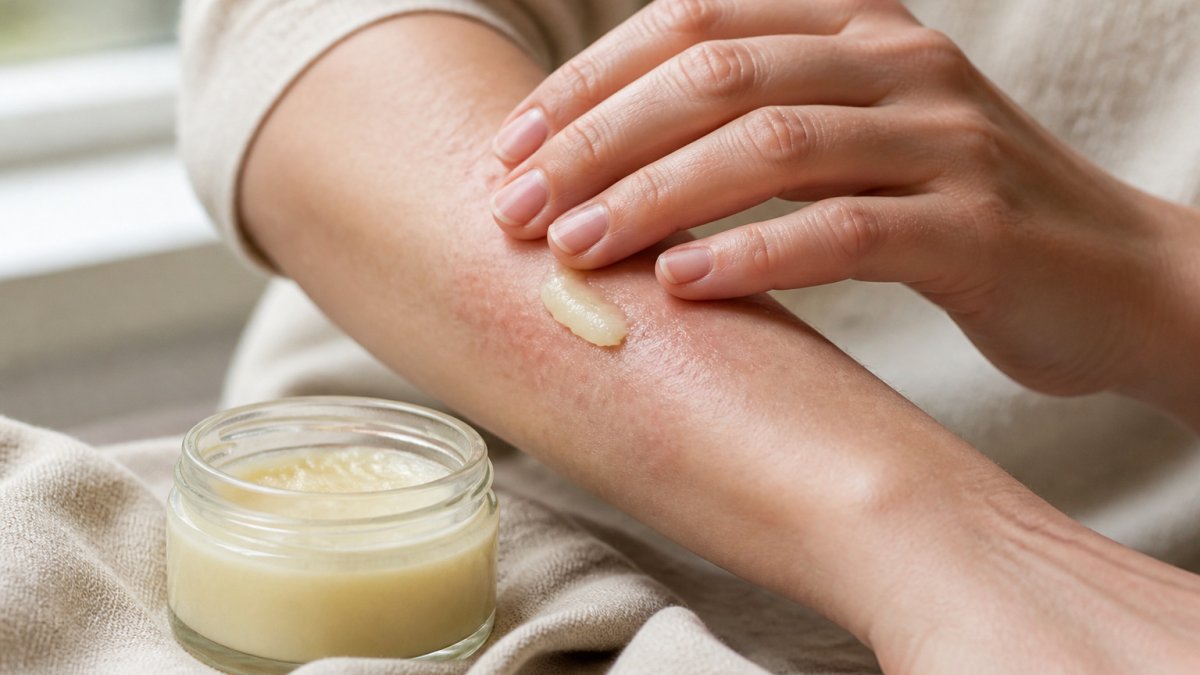
- Apply a thin layer. Use roughly the amount you would use on a small patch of eczema, about the size of a pea, and spread it over an area roughly 2 cm by 2 cm. Do not rub it in vigorously; a leave-on balm should sit on the surface.
- Leave it uncovered. Do not cover the area with a plaster or clothing that rubs. Air exposure is part of the test.
- Check at 24 hours, 48 hours, and 72 hours. Most irritant reactions appear within 24 to 48 hours, but some allergic reactions (particularly to fragrance or essential oils) can be delayed and appear at 72 hours or later. Note any redness, itching, stinging, swelling, or small bumps.
- Wash it off if you react. If you see any of the signs in the next section, wash the area with lukewarm water and a plain, fragrance-free cleanser, pat dry, and stop using the product.
- If there is no reaction after 72 hours, test again on a slightly larger area. Apply to a 5 cm by 5 cm patch on the forearm for another 48 hours. If that stays calm, you can try it on a small area of eczema-prone skin, such as a single dry patch on the arm or leg, before using it more widely.
What counts as a reaction
Stop using the product and do not retest if you see any of the following:
- Redness that spreads beyond the area where you applied the balm
- Itching or stinging that starts within minutes and does not settle
- Swelling, weeping, or a raised, bumpy rash
- Small blisters or a burning sensation
- A reaction that appears at 72 hours or later, even if it is mild, delayed reactions are a hallmark of allergic contact dermatitis and should not be ignored
A mild reaction that settles within a few hours of washing the product off is still a reason to stop. Do not "push through" a reaction in the hope that your skin will get used to it; with eczema, repeated exposure to an irritant or allergen tends to make the reaction worse, not better.
What a patch test cannot tell you
A patch test reduces the risk of a large-area reaction, but it is not a guarantee. It cannot rule out:
- Delayed reactions that appear after several days of continuous use
- Reactions on broken or inflamed skin, which is more permeable than the intact forearm skin you tested on
- Cumulative irritation from daily use over weeks, which is different from a single application
- Airborne or contact reactions to other products used alongside the balm
Eczema Skincare Ingredients to Avoid
Calm Balm (£30.00) contains calendula and chamomile alongside tallow, shea butter and beeswax. To see which ingredients suit eczema-prone skin, read Best Skincare for Eczema Prone Skin. Pure Whipped Tallow (£35.00) includes several botanical oils. For guidance on picking a moisturiser free of irritants, read How to Choose an Eczema Moisturizer.
How Tallow Balm Compares With NHS-Recommended Eczema Care
If your eczema is severe, keeps coming back, or is affecting your sleep or daily life, see a GP or dermatologist. They can recommend treatments with proven effectiveness for your condition. Think of tallow as an additional moisturiser, not a substitute for the care your doctor advises.
Pure Whipped Tallow | Face & Body Moisturiser →
When Not to Use Tallow Balm on Eczema, and Using It on Children
Tallow balm is a moisturiser, not a treatment, and there are situations where applying any occlusive balm can make eczema worse rather than better. Knowing when to stop and when to seek medical advice is as important as knowing how to patch test.
Do not use tallow balm on broken, weeping, or infected skin
Do not apply tallow balm, or any other rich occlusive, to skin that is:
- Weeping or oozing clear fluid or pus
- Bleeding or has open scratches from scratching
- Covered in yellow or honey-coloured crusts, which can be a sign of bacterial infection
- Hot, swollen, and painful to touch
- Spreading rapidly or accompanied by a fever
If you suspect an infection, do not self-treat with a balm. See a GP or pharmacist promptly. Infected eczema often needs prescription treatment, and delaying that can make the infection harder to clear.
Use during a flare
During an active flare, the priority is calming inflammation, not adding a new product. Most eczema guidance recommends continuing with your prescribed treatment and plain emollients during a flare, and introducing new products only once the skin has settled. If you want to try tallow balm, wait until the flare has calmed and the skin is intact, then patch test as described above.
Using tallow balm on children
- Infants under 12 months: do not apply tallow balm without medical advice. Speak to a GP or health visitor first, particularly if the baby has eczema, dry skin, or a history of reactions.
- Children aged 1 to 5: patch test first, using the protocol above, and choose the plainest product available, ideally one with no added fragrance or essential oils. Apply only to intact skin, and stop at the first sign of redness or itching.
- Children aged 6 and over: the same patch-test protocol applies. Children with eczema should continue with their prescribed emollients and treatments; a tallow balm is an optional extra, not a replacement.
- Teenagers: skin can be more reactive during puberty, and acne-prone skin may not tolerate rich occlusive balms well. Patch test on a small area and avoid applying to the face if the skin is oily or spot-prone.
In all age groups, keep the balm out of reach of children, store it as directed on the packaging, and check the expiry date before use.
When to see a GP or dermatologist
Book an appointment if:
- Your eczema is not improving with your current routine
- You are waking at night because of itching
- The skin is cracked, painful, or bleeding
- You suspect an infection
- You have reacted to a new product and the reaction is not settling
- You are considering a new product for a baby or young child
A GP or dermatologist can advise on treatments with proven effectiveness and help you build a routine that fits your skin. Tallow balm can be part of that routine if your skin tolerates it, but it should never delay medical care for eczema that is active, infected, or not responding to treatment.
Choosing Your Next Step: Testing a Calm, Simple Routine
The Sensitive Skin Starter Set (£50.00) pairs Pure Whipped Tallow and Calm Balm at a lower combined price than buying them separately. If you want to start with a single product, you can buy the Pure Whipped Tallow face and body moisturiser and test it first. Shop the Starter Set


Frequently Asked Questions
Is tallow balm safe to use on eczema?
For many people with mild, dry eczema, tallow balm is unlikely to cause harm, but safety depends on the individual. Tallow is an animal-derived fat that is generally well tolerated, yet some people react to it or to added ingredients such as fragrance or essential oils. Before using any tallow balm on eczema, do a patch test on a small area for several days, choose a fragrance-free version, and stop if redness, stinging or itching increases. If your eczema is inflamed, weeping or infected, speak to your GP or pharmacist first rather than applying a new product to broken skin.
Can tallow balm make eczema worse?
It can, in some cases. A flare-up after using tallow balm may come from the tallow itself, an added ingredient, or simply from the skin being irritated by the application. Watch for increased burning, itching, rash or cracking within a day or two of starting. Stop using the product, wash the area with lukewarm water and a gentle cleanser, and seek medical advice if symptoms do not settle. Keeping a note of what you applied and when can help you and your GP work out the cause.
Does beef tallow help eczema?
Beef tallow is a fat that can work as an occlusive emollient, meaning it helps reduce moisture loss from the skin surface. That may make it useful for dry skin in general, but there is limited direct clinical research specifically testing beef tallow for eczema. Emollients are a core part of eczema care in the UK, so tallow may fit into a routine as a moisturiser, provided it does not irritate your skin. It is not a replacement for prescribed treatments such as topical steroids where these have been recommended.
Is tallow balm suitable for babies with eczema?
Infant eczema should be discussed with a GP, health visitor or pharmacist before you introduce any new product. Babies have more delicate skin, and a product that suits an adult may not suit a child. If you are considering tallow balm for a baby or young child, choose a plain, fragrance-free version, test a tiny area first, and avoid applying it to broken or weeping skin. Stop and seek advice if the skin reacts.


