
Table of Contents
- Tallow Skincare for Sensitive Skin: What You Need to Know First
- Is Beef Tallow Good for Your Skin?
- How Tallow Skincare Supports a Compromised Skin Barrier
- Tallow Skincare Side Effects and Who Should Be Cautious
- How to Patch Test Skincare Before You Commit
- Building a Tallow Skincare Routine for Reactive Skin
- Reading a Tallow Label: Ingredients, Sourcing and Texture
- Conclusion
- Frequently Asked Questions
Last Updated: October 17, 2026
Tallow Skincare for Sensitive Skin: What You Need to Know First
Tallow skincare for sensitive skin uses rendered beef fat as its primary moisturising ingredient, and it has moved from farmhouse tradition into mainstream UK routines.

That simplicity is also where the caution lies. Sensitive skin is not one condition. Eczema, rosacea, acne-prone skin and plain reactivity behave differently, and a rich, water-free balm suits some far better than others.
Is Beef Tallow Good for Your Skin?
Beef tallow is good for dry, easily irritated skin when applied as a moisturiser and tolerated well. It is not a cure for any skin condition, and it will not suit every sensitive-skin type. The answer depends on your skin's current state, what else is in the product, and how you introduce it.
The fatty acid and lipid profile
Tallow is mostly a blend of saturated and monounsaturated fats, with a smaller proportion of polyunsaturated fatty acids. Skin's outer layer is built from lipids, including fatty acids, ceramides and cholesterol, so a fat close to that mix tends to feel compatible rather than foreign.
The result is a balm that melts at skin temperature and leaves a protective layer rather than a wet film.
What the evidence can and cannot tell you
There is no large body of clinical trial evidence on tallow as a skincare ingredient. Most claims come from traditional use, formulator experience and the known behaviour of the fatty acids involved, which is not proof.
What we can say with confidence is how occlusive and emollient ingredients generally work, and that reducing water loss supports a compromised barrier. If you want to understand how the skin barrier is structured and why lipids matter, the National Eczema Society guidance on emollients is a useful, plain-English starting point.
How Tallow Skincare Supports a Compromised Skin Barrier
Tallow skincare supports a compromised barrier by acting as an emollient and an occlusive layer: it softens rough, flaking skin and slows water loss. When the barrier works properly it holds moisture in and keeps irritants out; when it does not, skin feels tight, stings on contact with water and reacts to products it previously tolerated.
Emollient, occlusive and humectant roles
These three terms should not be used interchangeably.
- Emollient: fills the gaps between skin cells, making skin feel softer and smoother
- Occlusive: forms a film on the surface that reduces water loss
- Humectant: draws water towards itself, which can help hydration but needs something on top to hold it there
Tallow behaves mainly as the first two. It does not add water to skin, so apply it to slightly damp skin after cleansing, a habit that makes a noticeable difference by morning.
Tallow Skincare Side Effects and Who Should Be Cautious
The most common tallow skincare side effects are congestion, milia and contact reactions, and in most cases the culprit is not the tallow itself. Rich, water-free balms sit on the surface as an occlusive layer, which can be too much for oily or acne-prone skin. When a reaction occurs, it is far more often traceable to what else is in the jar.

Ingredient-level allergy and sensitivity risks
Tallow is a fat, and fats are rarely allergenic on their own. The additives are where problems cluster:
- Fragrance and parfum. The single most common cause of cosmetic contact allergy. "Parfum" can stand for dozens of undeclared compounds.
- Essential oils. Lavender, citrus, tea tree, peppermint and eucalyptus are natural but not neutral, and they are common in "natural" balms aimed at sensitive skin.
- Honey and beeswax. Usually well tolerated, but honey can carry trace pollen and beeswax can carry propolis. If a balm stings rather than soothes, suspect these.
A useful rule: if a balm contains more than one or two of the above and your skin is reactive, you are testing several variables at once. Start with the plainest formula you can find, then add complexity once the base is tolerated.
Acne-prone and rosacea-prone skin are not the same problem
These two sensitivity patterns get lumped together, and they need opposite handling.
Acne-prone skin is a congestion and sebum problem.
Rosacea-prone skin is a vascular and reactivity problem, not a congestion one, so the priority is trigger avoidance rather than oil control.
One more distinction: a brief sting on application is not the same as a reaction.
When to seek professional care
A balm is a moisturiser, not a treatment, and continuing to experiment can delay the right care. Speak to a GP or pharmacist if:
- A rash is spreading, blistering, weeping or painful rather than just dry and tight
- You have a diagnosed condition such as eczema, rosacea or psoriasis that is flaring despite your routine
- You have used a product for two to three weeks with no improvement, or with worsening
If you want to understand how emollients are used in diagnosed skin disease and where a plain moisturiser fits, the NHS overview of rosacea and the National Eczema Society guidance on emollients both set out when self-care is reasonable and when to seek advice.
The honest trade-off
Tallow is a good emollient and occlusive. If your skin is reactive because of a damaged barrier, a plain occlusive can genuinely help. If it is reactive because of an active condition, the balm is comfort, not cure, and should sit alongside proper care rather than replace it.
Sensitive Skin Starter Set | Pure Whipped Tallow + Calm Balm →
How to Patch Test Skincare Before You Commit
A patch test is a short, controlled introduction of a new product to a small area of skin before wider use. It will not catch every reaction, but it reliably catches the obvious ones and costs only a few days.
Here is the routine we suggest:
- Choose the site. Inner forearm or behind the ear, on clean, unbroken skin.
- Apply a small amount. Roughly the size of a grain of rice, on its own, with nothing layered over it.
- Leave it for 24 hours. Do not wash the area during this window.
- Check and repeat. If there is no redness, itching or swelling, repeat on a small area of your face, such as the jawline.
- Wait 48 hours. Reactions can be delayed, so give it two full days before wider use.
- Introduce one product at a time. If you are testing a set, space each product a week apart so you know what caused any reaction.
Stop immediately if you develop swelling, spreading redness, blistering or itching that keeps you awake. That is a reaction, not a purge.
Building a Tallow Skincare Routine for Reactive Skin
Reactive skin does best with fewer steps. A workable routine is cleanse, apply balm to damp skin, and stop. Everything else is optional and should be added only once your skin has been stable for a couple of weeks.
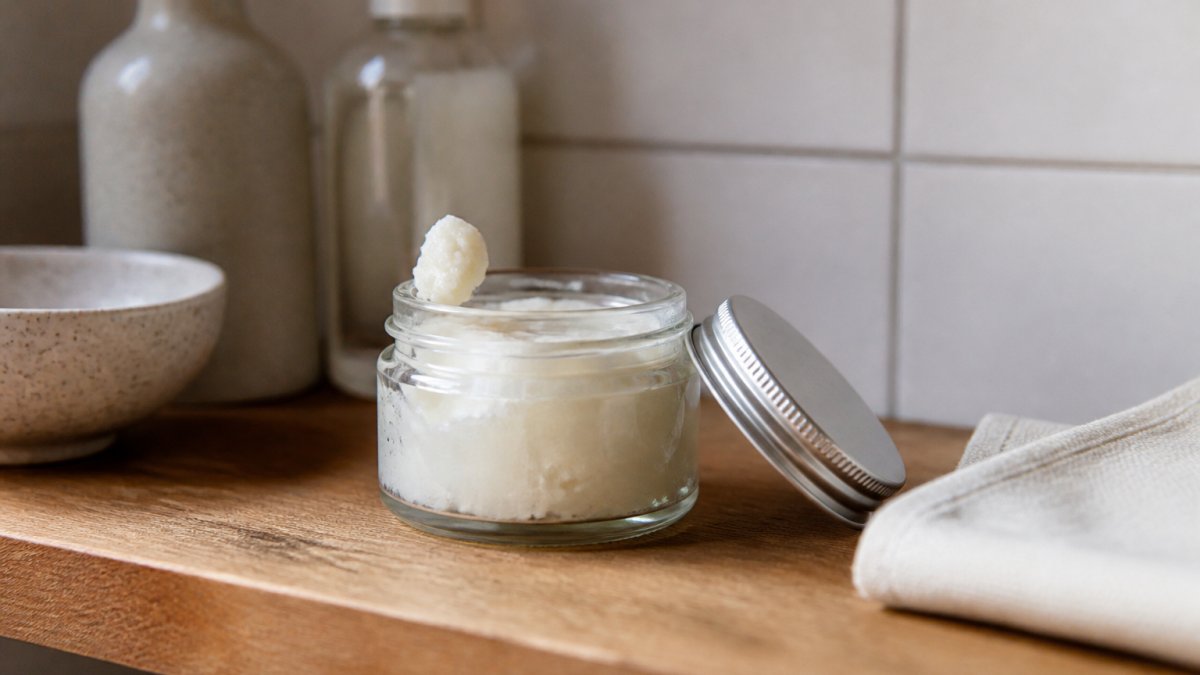
Morning and evening look much the same: gentle non-foaming cleanser with lukewarm water, pat dry, then warm a pea-sized amount of balm between your fingertips and press it into your face.
Our Sensitive Skin Starter Set | Pure Whipped Tallow + Calm Balm at £50 pairs an everyday whipped tallow moisturiser with a concentrated balm for dry patches, so you are not buying two full routines to find out what your skin tolerates. If your scalp is also reactive, the Skin & Scalp Ritual Set | Calm Balm + Tallow + Thrive™ at £62.50 adds a pre-wash scalp oil to the same routine.
Reading a Tallow Label: Ingredients, Sourcing and Texture
A good tallow label tells you three things quickly: what the fat is, what else is in the jar, and how the product is made. Most labels do the first two badly and the third not at all.
Ingredients: what to look for and what to avoid
Look for tallow listed first, followed by a short list of oils, butters and waxes. Fewer than ten ingredients is a reasonable benchmark. Beyond that, screen for:
- "Parfum" or "fragrance." On a product aimed at sensitive skin, this is a reason to keep looking, an umbrella term that can hide dozens of compounds.
- A long essential-oil list. Lavender, citrus, tea tree, peppermint and eucalyptus are natural but not neutral, and they are the most common cause of contact reactions in "natural" balms.
- Preservatives in a water-free product. A genuinely anhydrous balm does not need preservatives, because there is no water for microbes to grow in. If you see phenoxyethanol, potassium sorbate or similar in a balm claiming to be water-free, either the formula contains water or the maker is hedging. Ask why.
Sourcing: what "grass-fed" actually tells you
"Grass-fed" and "pasture-raised" describe the animal's diet and living conditions. They tell you something about the fat's quality and nothing about how it will behave on your skin. Do not treat them as a safety or efficacy claim.
What matters more is the rendering and purification, which the label rarely states. Suet, the fat around the kidneys and loins, is the usual choice for cosmetic tallow because it is firmer and less strongly flavoured than fat from other parts.
Manufacturing quality: the questions a label should answer
This is the part that separates a careful maker from a hobbyist. A label or product page that answers these is doing its job:
- Rendering method. Wet rendering (with water) versus dry rendering (fat alone) affects colour, smell and how clean the final fat is. Either can be done well; neither is stated on most labels.
- Batch and date. A batch number and a made-on or best-before date let you trace a problem and judge freshness. Oils oxidise, and an old balm is a more irritating balm.
- Storage and shelf life. Anhydrous balms are stable but not immortal. Cool, dark storage and a stated shelf life of around 12 to 24 months is typical. No date at all is a warning sign.
Texture: what it tells you about the formula
Whipped tallow should be soft enough to scoop with a fingertip and melt on contact. A balm that stays hard will drag on skin and pull at reactive areas; one that turns to liquid at room temperature has likely been cut with a soft oil or over-whipped. A well-made balm holds its structure at room temperature and softens the moment it meets skin.

A label checklist
| What to check | Good sign | Warning sign |
|---|---|---|
| Ingredient list | Short, tallow first, no fragrance or essential oils | Long list, "parfum" high up, many botanicals |
| Preservatives | None in a genuinely water-free balm | Preservatives present with no water declared |
| Sourcing | Named grass-fed or pasture-raised fat, suet preferred | No sourcing information at all |
| Rendering | Pale, near-odourless, smooth | Strong beefy smell, gritty texture |
| Batch and date | Batch number and best-before stated | No date or batch detail anywhere |
| Storage advice | Cool, dark, clean dry hands or spatula | No storage guidance |
| Packaging | Glass, ideally dark or amber | Opaque plastic with no detail |
| Claims | Moisturises, softens, comforts | "Treats eczema," "cures rosacea," "heals" |
If a product page answers most of the left-hand column, the maker is paying attention. If it answers none and leans on "natural" and "ancestral" instead, you are being sold a story rather than a formula.
Conclusion
Finding a moisturiser that calms reactive skin instead of provoking it is genuinely difficult, and most people get there by trial and error. Start with a patch test, introduce one product at a time, and judge a balm on how your skin feels after two weeks rather than two days.
At Izzy Rose Skin, our concentrated tallow formulas are built for exactly this problem: fragrance-free, made in small batches, and short on ingredients. The Pure Whipped Tallow | Face & Body Moisturiser at £35 is our everyday starting point, and the Calm Balm | Multi-Purpose Balm for Dry Skin at £30 handles the stubborn patches.
Frequently Asked Questions
Is tallow skincare suitable for sensitive skin?
It can suit sensitive skin because tallow balms are typically water-free, fragrance-free and built from a short ingredient list, which reduces the number of things that can trigger a reaction. Tallow is rich in fatty acids and lipids that behave like an emollient, softening skin and slowing moisture loss. Suitability still depends on the individual: some people react to lanolin-like or botanical additions such as essential oils. Patch test on the inner forearm for 48 hours before applying to the face.
Can tallow clog pores or cause breakouts?
Tallow is an occlusive, fatty ingredient, so it sits on the surface rather than sinking in quickly. For dry or dehydrated skin that is usually welcome. For acne-prone skin, heavy balms can contribute to congestion, particularly if applied thickly over the whole face. Start with a pea-sized amount on the driest areas only, keep the rest of your routine light, and stop if you notice new closed bumps. Comedogenicity varies by person, not just by ingredient.
How should you patch test a tallow skincare product?
Apply a small amount to clean skin on the inner forearm or behind the ear, twice daily for 48 hours. Leave it uncovered and do not wash the area more than usual. Watch for redness, itching, stinging, swelling or a rash. If nothing appears, repeat on a small patch of jawline for another two days before using it on your full face. Stop immediately and seek advice from a pharmacist or GP if a reaction spreads or blisters.
Can you use tallow skincare if you have eczema or rosacea?
Many people with eczema find water-free, fragrance-free balms comfortable because they add a protective layer and reduce moisture loss, which can ease tightness and dryness. Rosacea is different: flushing and redness are often triggered by heat, friction and certain ingredients, so a rich balm may feel too heavy for some. Introduce one product at a time, keep it minimal, and speak to your GP or dermatologist if symptoms worsen or do not settle.


